Adobe create problems for their users

It has been brought to my attention that there are some problems with creating ePUB documents with Adobe Indesign 5.0.

Apparently Adobe have fixed the problems but rather than allow users to receive an update they are telling them to upgrade to 5.5 to get the fix.

Is that a fair thing to do? Im sure there are people who happily pay for new products when the ones they have are faulty but it doesn’t seem right to me.

More to come
Adobe also plans to radically change  the system where users of their software could upgrade to the latest version of the program for an upgrade fee. In the past you would have paid something like £160 ($248.00 US) for an upgrade from say Photoshop CS2 to CS5. Now the planned upgrade version to CS6 is only available if you own the previous release meaning that if you have missed out on the upgrade to CS5 but wanted to upgrade your CS4 ,3 or 2 to CS6 you will need to pay the full price of the program again.

This will mean that someone moving to Photoshop CS6 will have to pay the same as someone who hasn’t paid Adobe in the past. Currently Photoshop CS5 sells on the Adobe store for £548 excluding sales tax (VAT) – that is $851 US.

Clients who are not VAT registered will need to pay £657 or its equivalent for the upgrade (that’s over $1,000.00 US) when moving to Photoshop CS6 and assuming the price remains the same as current.

Adobe have offered a time limited plan for users of CS2,3,4 to upgrade to CS5 at 20% less  then pay the separate upgrade to CS6 when it comes out, very generous of them to offer this?

Clearly we are in an unhealthy situation where Adobe are feeling strong enough to milk their customers. Once dominant companies such as Quark have in the past also gone through such a stage.

In a competitive market this does not happen, market failure is causing Adobe to move to a place it should not be. In the future we need to be cautious with dealing with this ugly aspect of the company, this means expecting the software to function as specified, if we are to pay (much) more then we need to demand more.

Here is the statement from a serious user of Adobe software who was kind enough to write to me detailing her story:
I was using InDesign CS5 to create an ePub of my new book, The Global Indie Author: How anyone can self-publish in the U.S. and worldwide markets. (I am both a writer and a photographer.) The export to ePub utility in CS5 is full of bugs that are program-specific, meaning they are not the result of unforeseen issues with your OS or in conflict with another program. It was clear InDesign CS5 had been released prematurely: there was no way the programmers didn’t know about these bugs. To add insult to injury, Adobe didn’t release any patches; they simply “fixed” the problems for CS5.5 and told consumers to upgrade. It was outrageous. The analogy I made was to a car with a manufacturing defect: the company is forced by law to perform a recall; they can’t just say, “Oh, we fixed that problem in the next model; just go buy a new car.” Yet this was precisely what Adobe was doing. So I complained both publicly and directly to Adobe and they offered me a free upgrade to CS5.5. I have no illusions it was to neutralize the threat I posed, and fair enough. But I hope others will realise that Adobe is not so big that they are impervious to consumer ill-will.
Michelle Demers


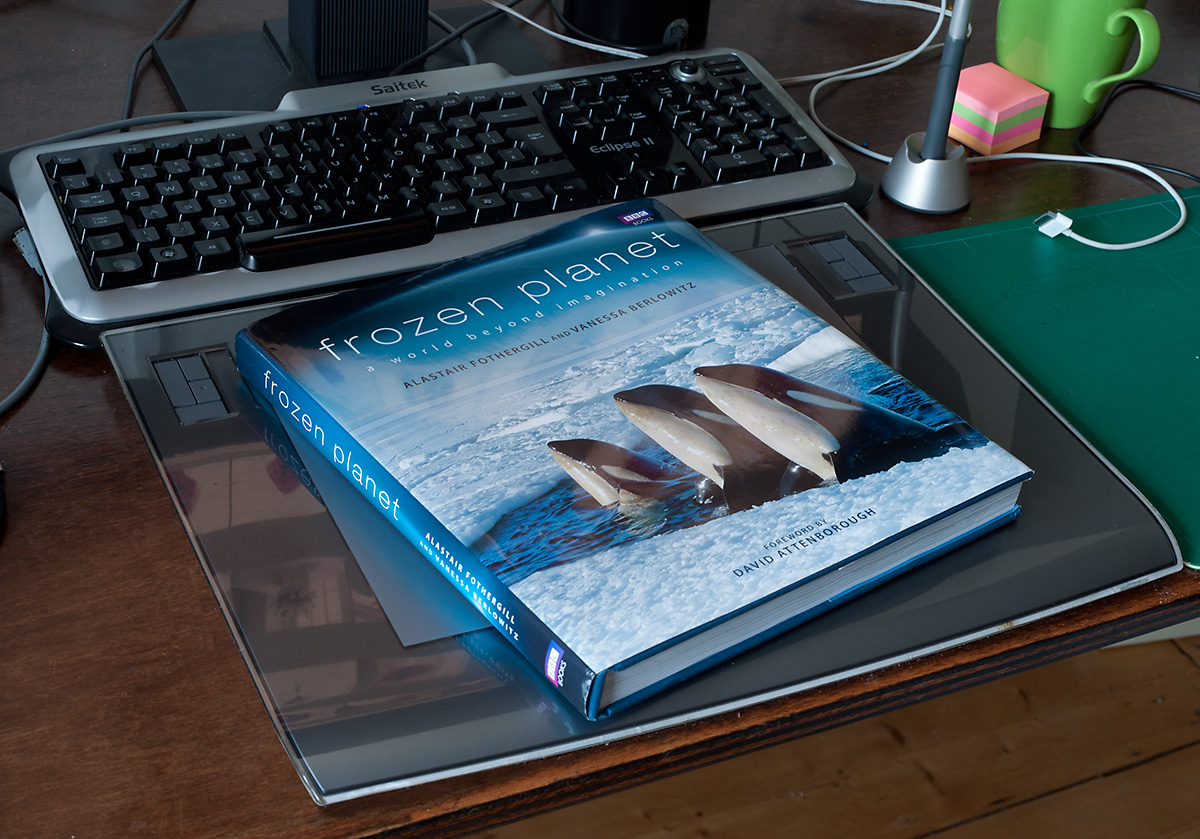
Client Story: Random House / BBC Books / Frozen Planet

With the exciting BBC Frozen Planet series due to be aired on TV this month I’m pleased to reveal my work on the accompanying book of the series.

I was asked to prepare all the images for the book. I worked closely with the designer supplying colour managed and exactingly sharpened CMYK images from supplied RGB originals.

The most important part of the work was to ensure tonal and colour consistency between series of shots. As often happens sequences were filmed with multiple cameras and bringing together their disparate shots can reveal quite major exposure differences that spoil the consistency of the scenes portrayed, it was my job to provide a better visual match whilst retaining accuracy and the integrity of the shots. Such as sequence in the book is in chapter 5 covering the hunting of bison by wolves.

There was a variety of sources for the images from high quality RAW files to HD screen grabs that needed careful interpolation and sharpening to work on the printed page.

In TV and Film production the process of colour balancing images in sequence is called “grading”, what I offered was the stills equivalent and was very pleased to receive an email from the authors Alastair Fothergill and Vanessa Berlowitz thanking me for doing the work. This meant a lot to me as is so often the case I found myself immersed in the subject matter and wanted to get the best possible results.

If you have an important book project and want the very best results from the images then please feel free to contact me, its not a costly process given the difference that good grading and preparation can make.

The Frozen Planet book is now available and can be purchased on-line, here is Amazons page of the book:
http://www.amazon.co.uk/Frozen-Planet-Alastair-Fothergill/dp/1846079624/ref=sr_1_3?ie=UTF8&qid=1319471881&sr=8-3


Client Story: Hard Rain Project

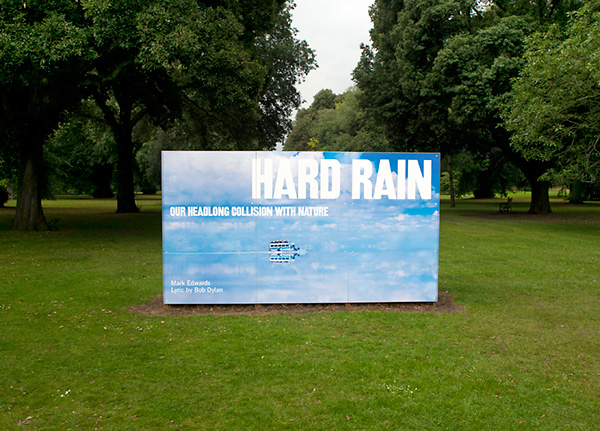
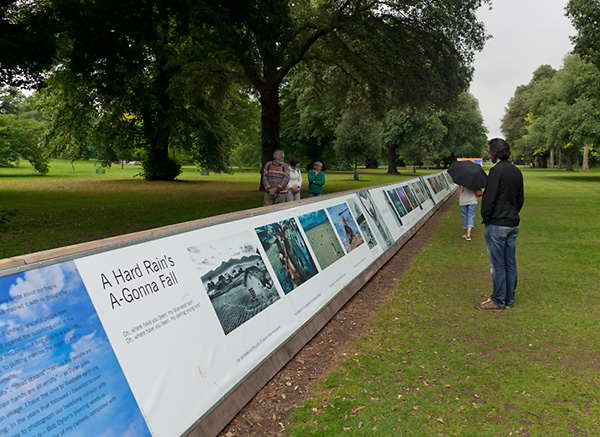
HARD RAIN: What’ll You Do Now?
at the Royal Botanic Gardens, Kew till 25th September 2011

Mark Edwards has used his original Hard Rain Project set of images as the core element of a new project that considers how we can as individuals and as a society can move towards a sustainable future for the Planet.

This powerful exhibition is currently on show at Kew Gardens in London, you can read all about the project and the exhibition here:
http://www.hardrainproject.com/

Kudos to the management of Kew Gardens for allowing some “difficult” images amongst the beauty of the gardens,  in my opinion this raises their profile as a conservationist organisation  and the garden location is exactly the right place for thousands of people each day to consider the issues raised.

Photography is at its best when it combines passion with meaningful subject matter and this exhibition has plenty of both. I recommend you visit the site or exhibition as it travels the world.

My involvement
I have worked with Mark to help prepare the images for printing for both this outdoor exhibition as well as for the book and Audio Visual uses.

Careful colour grading and consideration of Marks preferences for tonality means that the exhibition has a consistency of vision in the printed results.

Image restoration was part of the work undertaken to allow for the enlargement of low resolution images to 1 meter or more, I was always careful to keep the veracity of the underlying image and keep the image pure whilst reducing noise, chromatic aberration and other artifacts that would have impeded the message or meaning of the image coming through.

If you are planning a book or exhibition and have material from multiple sources it will always pay you to have me look at the material and quote on preparing the files for greater clarity and consistency and give greater readability to the work.

Stephen


x-rite do the right thing for potential OSX Lion users

It looks like x-rite have decided to include support for their older hardware (such as the i1 display 2) in i1profiler software (specifically i1Basic) which is designed to run on  OSX 10.7 (Lion).

They have done this after an outcry from users and suppliers who have rightly pointed out to them that not supporting their recent hardware is not the behaviour of a company that cares about its users.

So all very positive, though according the the table in the following link there will be a “nominal” fee if you bought your i1 display 2 before 2011, lets hope they drop the fee and just do the right thing.

http://www.xrite.com/custom_page.aspx?PageID=264

September is still some way off so don’t update to Lion till they release this, – a calibrated screen is far more important than sliding icons and App store jiggery pokery.

Stephen


Higher capacity Image Storage from Synology

For people who need greater digital image storage capacity than the current affordable 10.9TB Thecus then you may want to have a look at the following solution:

http://www.storagereview.com/synology_targets_photographers_new_ds2411_nas

I would estimate that filled with 3TB drives this should provide between 24-30TB of usable Raid 5 space (36TB unformatted). To put this in perspective thats enough for over  1/2 million uncompressed A3+ Tiffs or over 1 million camera raw images.

Synology have a good reputation for building solid kit so this look like a viable way to accommodate image collections. The 165mb/sec writing and 195mb/sec reading in raid 5 mode means that access to images is not going to be a problem.

As always – this is not a backup solution in itself, copies of all files must exist in some form as the device is a single point of failure (theft etc). What it does provide is fast and simple access to a large image collection.


Alert:Windows ATI Radeon 4870 video card / CS5 / CMYK / Problem

A bit of an obscure one this as I know clients with the above graphics card either don’t use Photoshop CS5 or never work in CMYK but I’m putting this information out there for people who may see the same problem.

With current and recent drivers switching screen mode in Photoshop (the F key) causes the display of a CMYK image to go saturated/incorrect.
I always advise clients the F key is a great way to view your images against black or white as well as the default grey surround. The display of the image against black allows you to spot weak / grey shadows and against white allows you to check highlight areas as they would print on paper.
Unfortunately with recent Windows ATI drivers and Photoshop CS5 *and* CMYK images the colours within the image distort in the different display modes. This does not happen with an RGB image!
Because I prepare images for rerpo I do need to have accurate CMYK previews so have invested in a Nvidea GTX 550Ti card with 2GB of memory, this card does not have the same problem and its extra memory is a real bonus when opening lots of images in Open GL mode. It also has the advantage that I can use the Graphics card processors (Cuda cores) to help calculate and apply noise suppression using the latest version of Neat Image noise reduction.
When I first started using Neat image it took up to 60 seconds to process an A3/300dpi image, now with the help of the new video card this is reduced to a few seconds.
Reading round the edges it would appear that Adobe engineers are using HP workstations with Nvidea graphics cards when developing Photoshop, the card I have bought is quite modest (approx £100) but is sufficient for Photoshop, clients using Adobe Premier will benefit from a faster Nvidea card that will aid real time video rendering.
All a little sad really as I was more than happy with my ATI card till now, but its more important that I can trust my screen and that’s why I made the change.
Stephen

i1 display 2 support under Lion

There wont be any.

Well that’s the short version. Since i1match software relies on the software transition layer called “Rosetta” to run on Intel Macs and “Rosetta” is dropped from OSX 10.7 (Lion) it is not possible to directly run the program on a machine running Lion without some very faffy workarounds.
The new i1Publish software does not support the older hardware but it does (surprise) support the new Xrite monitor calibrators they have just released.
Since there really is no compelling imaging reason to upgrade to Lion then I strongly advise that you don’t, you will save money and be able to easily calibrate your screen for a colour correct workflow.
However! at some point an upgrade will become important (newly released software/patches etc) that need Lion or one of its successors; I will therefore be testing out the new screen calibrators in the near future and report back.
In the meantime you can read some detail here from Rob Griffith with a very kind offer if you bought your i1 display 2 from them recently:
Xrite are not kind, they could easily have supported the older hardware on the new i1 software if they wanted to, its the kind of rough behaviour that comes from dominating the market by buying your biggest competitor (Gretag Mackbeth)….

OSX Lion

Because of the way the new Apple operating system will work there are problems with older legacy programs including colour management programs from xrite such as i1match many of you use to profile your screens.

Until I have tested work arounds and solutions I don’t recommend that clients upgrade to Lion just yet.
To be honest the upgrade looks to be less than compelling so you wont be missing much in the meantime.
Stephen